
Think of democratic leadership as the conductor of a community choir. While they stand at the front to keep the tempo, they don’t produce the music alone. They listen carefully to the sopranos, the altos, and the tenors, ensuring that every singer’s voice is heard and balanced. The final, beautiful harmony isn’t just the conductor’s work; it belongs to every person on the stage because they all chose the notes and sang them together.
Leadership is an invitation to gather around a shared table, where every voice has a place, and every idea is given the room to breathe. It is the belief that the best path forward isn’t found by one person alone, but is discovered together through conversation and connection. This approach, known as Democratic Leadership, transforms leading into a collective journey, ensuring that everyone involved feels a true sense of belonging and purpose in the work they do.
1. Description of Democratic Leadership
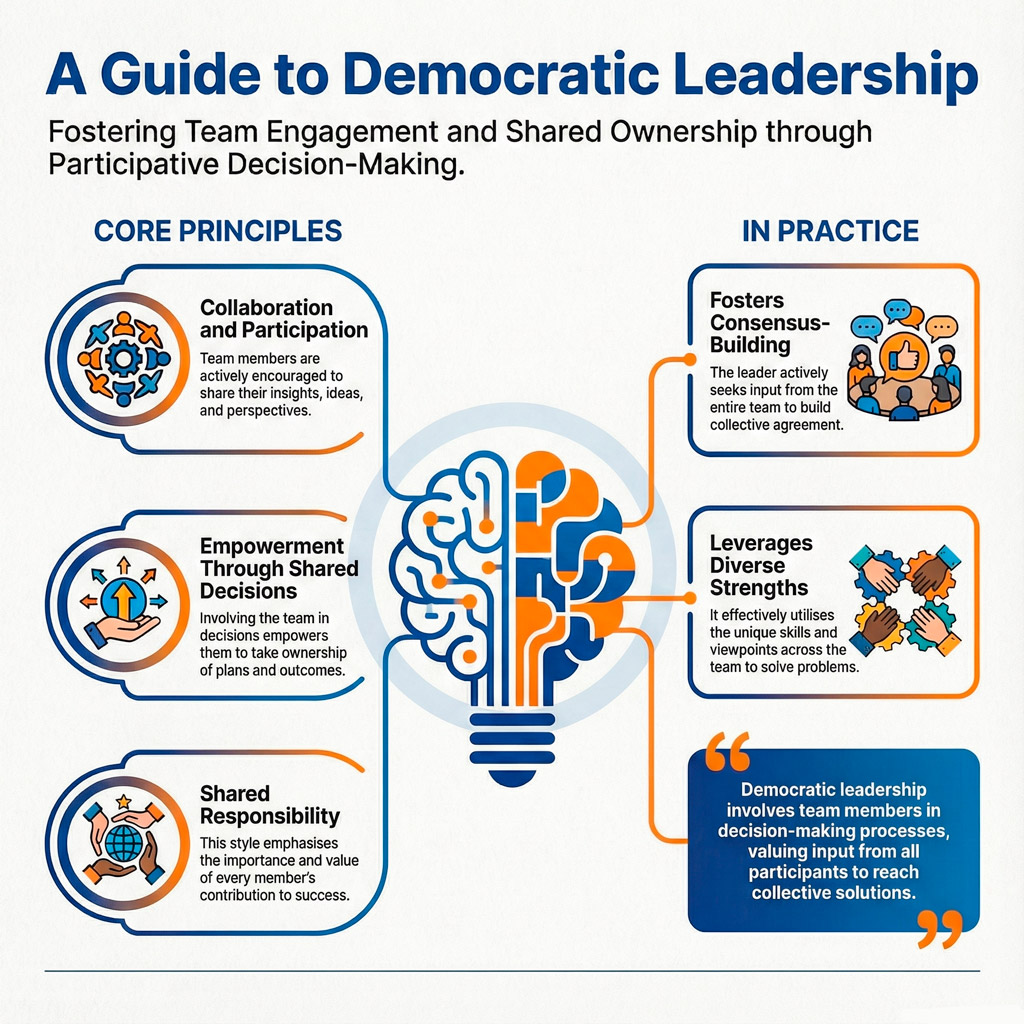
Democratic leadership is a participative style that involves team members directly in the decision-making process. Rather than orders coming from the top down, this style values the input of all participants to reach collective solutions. It is designed to foster deep engagement and a sense of ownership, as people are much more likely to support a plan when they have helped to shape its direction.
2. Democratic Leadership’s Qualities
A democratic leader acts as a facilitator of talent, bringing people together to weave their individual strengths into a stronger whole:
• Active Collaboration: They actively seek input and encourage team members to share their insights and ideas.
• Consensus-Building: They focus on fostering consensus, working to find a way forward that the entire group can support and believe in.
• Empowering Participation: They use shared decision-making to give the team a real voice, allowing them to influence the outcome of projects.
• Leveraging Diversity: They are skilled at utilising diverse skills and perspectives, recognising that different backgrounds lead to more creative and robust solutions.
• Encouraging Initiative: They empower team members to take ownership of plans, trusting them to lead within the areas they know best.
3. Democratic Leadership’s Values
At its heart, this style is rooted in a deep respect for the individual and the power of the collective:
• Shared Responsibility: a core value is the belief in shared responsibility, where the importance of every member’s contribution is recognised and celebrated.
• Inclusivity: this style prizes a culture where everyone’s voice is heard and considered, ensuring that no one feels left out of the conversation.
• Collective Wisdom: it values the idea that the best solutions arise from working together, rather than relying on the knowledge of a single person.
• Mutual Respect: it holds the value that by leveraging diverse strengths, the organisation becomes more resilient and innovative.
——————————————————————————–
Back to Leadership Styles Wiki